Why Did the Dogs Have to Die?
The kindest thing a book can do is tell the truth

May 1, 2026
Hello friends,
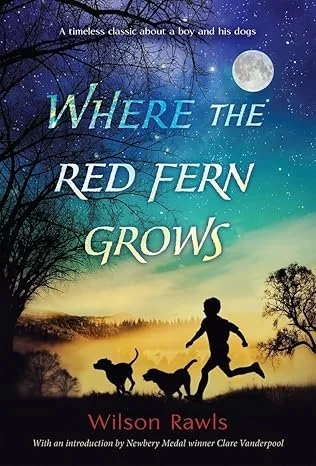
I first discovered the power of the read-aloud novel when I read Where the Red Fern Grows by Wilson Rawls to my grade 5 class. I don’t remember how I stumbled upon the book, whether it was recommended by the school librarian or whether the cover caught my eye (two dogs, now there’s a story!), or whether the description on the back cover piqued my curiosity (dogs named Old Dan and Little Ann – how could I not read the book?).
Where the Red Fern Grows was not the first read-aloud book I had shared with a class but there was something magical about this one. From the first chapter, I could see only rapt attention on faces around the room. My students were into the story from the get-go, caught up in the drawl of the author’s voice and wrapped up in the plot already.
Each day, usually after recess, I read a chapter. It settled the class, and it felt as if we had embarked on a journey together. The words flowed – not elaborate words, but simple ones that matched the narrator’s southern voice and the sparseness of his backwoods setting. Together, we were emotionally invested in the story, in 10-year-old Billy Colman’s longing for a dog and his quest for adventure with his companions, Old Dan and Little Ann. If for some reason, I moved on to another subject too soon, cries of “Don’t stop” rang out across the room.
Here and there we talked about the story, about how and why Wilson Rawls might have written it that way, and we made predictions about what was to come. But when I read the last few chapters, I was as heartbroken as the kids. No. It can’t be. Not Old Dan. Not Little Ann, too.
There were sniffles around the room, even from the bigger, and supposedly tougher boys. I felt I should say something, but what? These were 10- or 11-year-old children, not adults accustomed to death and the overpowering grief it instills.
We talked afterwards of the finality of death and the burden of grief carried by those left behind. They told me of pets who had died, of grandparents who had slipped away. Then, a hand rose.
“Why did the dogs have to die?” a student asked.
I can’t recall how I answered the question, but I think I know how I would answer it now. Wilson Rawls could have ended the story any number of ways. But if we examine the plot, if we follow the trail, it leads to that conclusion. It's the story's fulfillment. Rawls spends the whole novel building Billy's love for those dogs and when the loss comes, the size of his grief is exactly proportional to the size of his love. You can't have one without the other, and a story that protected Billy — and my students — from that loss would have betrayed everything it spent 200 pages earning.
Were the deaths too much for my students? Did the book glorify violence? Did it splatter blood all over the page? (Spoiler alert: one dog is fatally attacked by a mountain lion, and the other dies mourning its sibling while lying on its grave).
I didn’t think so, but along with other titles like To Kill a Mockingbird, the book has been challenged in various school settings, appears on Banned Books Week lists, and has been cited for violence and death. Which leads to a question. Aren’t those who challenge it doing just what Rawls chose not to do: soften the ending, removing the weight, deciding that children can't carry it?
My students didn’t need a softened touch. They needed an honest ending that matched their emotional investment. On that, Rawls delivered. The hand that went up afterward wasn't a sign of damage. It was a sign of engagement, of a reader grappling with something real.
I’ve carried that lesson into my own writing. When I wrote Coop the Great (Caution: another spoiler alert), Mike dies and leaves his dog Coop to mourn the loss. Mike’s death is a surprise, but not totally unexpected given the context of the story. After all, Mike is old, has difficulty walking, takes a boatload of pills, and receives news from his doctor that all is not well with his health. The clues are built into the story, and Coop’s grief when it comes is equal to the love Mike fostered.
We all want to protect our children, but a story that shields its readers from difficulty isn't being kind — it's being dishonest. It robs them of the chance to feel something real, in safety, alongside others. The real kindness is the difficulty itself.
Note:
If you haven’t yet, consider joining my mailing list below. You’ll get an email each time a new issue of Behind the Books is released on this website. You can expect reflections on writing fiction and nonfiction for young readers, background stories behind my books, and recommendations for books worth passing on. I also share the kinds of classroom and reading connections that don’t fit easily into social media posts.
This is not a marketing blast. I won’t flood your inbox. Expect an email once or twice a month. I’ll only send it when I have something that is worth your time to read.